
OKRImpact Board: A Systemic Approach to Sustainable OKR Implementation
OKRImpact Board: A Systemic Approach to Sustainable OKR Implementation
Implementing OKRs successfully is not a tooling challenge—it is a system challenge.
Many organizations launch OKRs with strong intentions, only to see them lose relevance after a few cycles. Objectives drift away from strategy, teams focus on activities instead of outcomes, and OKRs become a reporting exercise rather than a driver of learning and performance.
The OKRImpact Board addresses this challenge by helping organizations implement OKRs sustainably, treating them as part of an outcome-driven operating system—not a standalone goal-setting framework.
Why Sustainable OKR Implementation Is So Difficult
Across industries, the same root causes appear when OKRs fail to stick:
- OKRs are not clearly linked to strategy and long-term outcomes
- Teams confuse outputs with outcomes
- Leadership uses OKRs for control instead of learning
- Existing KPIs and incentives undermine OKR behavior
- Digital tools are implemented without cultural change
This results in mechanical OKRs—well-formatted objectives that fail to influence real decisions.
As outlined in the OKR Institute’s work on creating outcome-driven cultures, sustainable OKRs require fundamental system change, not superficial adoption.
👉 https://okrinstitute.org/outcome-driven-culture/
What Is the OKRImpact Board?
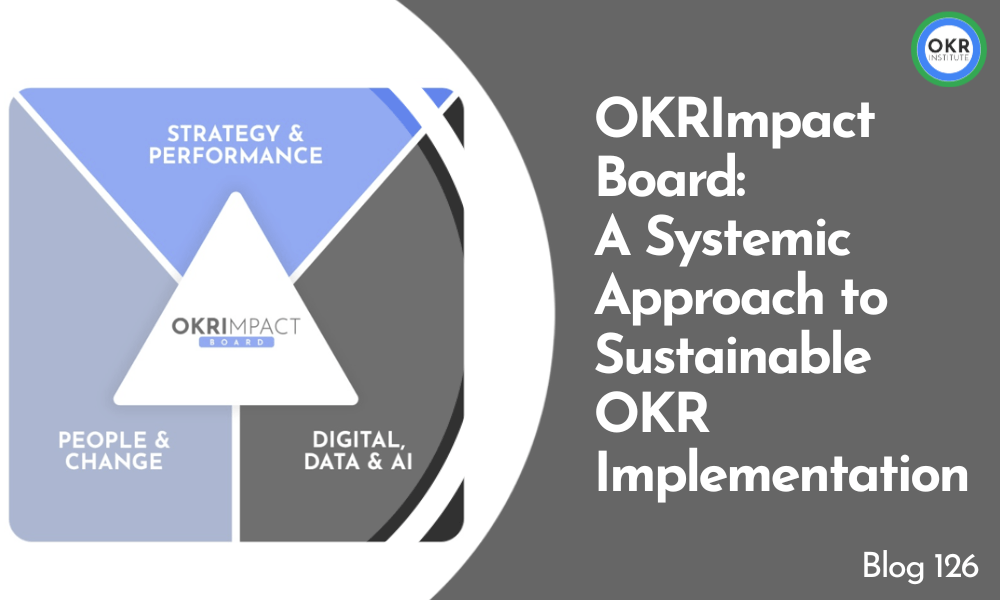
The OKRImpact Board is a systemic reflection and alignment framework that helps organizations design the conditions required for long-term OKR success.
Rather than asking only:
“Are our OKRs written correctly?”
The OKRImpact Board helps organizations ask:
“Are our OKRs driving meaningful outcomes across strategy, people, and execution?”
It integrates three interconnected dimensions that determine whether OKRs create lasting impact.
Strategy & Performance: Connecting OKRs to What Truly Matters
OKRs only create value when they are anchored in strategy, mission, and outcomes.
The OKRImpact Board helps organizations:
- Translate vision into clear strategic outcomes
- Connect long-term, mid-term, and short-term objectives
- Reduce fragmented KPIs and competing priorities
- Shift from task completion to impact measurement
This aligns directly with the OKR Institute’s perspective on outcomes over outputs, which explains why OKRs are fundamentally different from traditional KPIs.
👉 https://okrinstitute.org/okrs-vs-kpis/
Instead of asking “Did we deliver the initiative?”, teams begin asking “Did we create the intended outcome?”
People & Change: Embedding OKRs into How Work Actually Happens
OKRs rarely fail because of poor goal design.
They fail because behavior and leadership do not change.
The OKRImpact Board explicitly addresses the people and change dimension, helping organizations:
- Shift from command-and-control to empowerment and coaching
- Build transparency and peer accountability
- Enable cross-functional collaboration around shared outcomes
- Strengthen leadership behaviors that support OKRs
The OKR Institute emphasizes that leaders must act as visionaries, architects, catalysts, and coaches—not just goal approvers.
👉 https://okrinstitute.org/okr-leadership/
When OKRs are embedded into leadership routines, team rituals, and feedback loops, they evolve from a framework into a cultural capability.
Digital, Data & AI: Enabling Learning and Adaptability at Scale
As organizations grow in complexity, spreadsheets and static dashboards are no longer sufficient to support effective OKR execution.
The OKRImpact Board highlights how digital, data, and AI capabilities can:
- Increase transparency across teams and dependencies
- Enable evidence-based decision-making
- Support faster learning through insights and patterns
- Reduce administrative overhead in OKR tracking
Crucially, technology is positioned as an enabler, not the driver.
For a broader perspective on how OKRs support modern strategy execution, this Harvard Business Review article provides useful context:
👉 https://hbr.org/2018/01/with-goals-fast-beats-smart
How the OKRImpact Board Enables Sustainable OKR Adoption
What differentiates the OKRImpact Board from many OKR canvases and tools is its systemic nature.
It helps organizations:
- Diagnose why OKRs are not creating impact
- Balance strategic clarity with team autonomy
- Avoid turning OKRs into static KPIs
- Continuously evolve OKRs as the organization matures
This aligns with the OKR Transition Framework developed by the OKR Institute, which emphasizes learning, practice, and cultural reinforcement over time.
👉 https://okrinstitute.org/okr-transition-framework/
Rather than asking “Are we doing OKRs correctly?”, organizations begin asking:
“Are OKRs helping us become more outcome-driven over time?”
That shift is the foundation of sustainability.
From OKRs as a Framework to OKRs as an Operating System
At the OKR Institute, OKRs are not viewed as a standalone methodology. They are part of a broader transition toward outcome-driven ways of working.
The OKRImpact Board supports this transition by:
- Anchoring OKRs in strategic intent
- Embedding them into leadership and team behavior
- Leveraging digital capabilities to scale learning and performance
When these elements come together, OKRs stop being an initiative—and become a core element of how the organization thinks, decides, and executes.
Final Thoughts: Making OKRs Stick
Sustainable OKR implementation is not achieved by:
- Writing more ambitious objectives
- Adding more Key Results
- Introducing tools alone
It is achieved by designing the right system.
The OKRImpact Board provides organizations with a practical, holistic way to ensure OKRs drive meaningful outcomes—today and in the future.
For organizations serious about moving beyond “OKRs on paper” toward a thriving, outcome-driven culture, the OKRImpact Board offers a powerful starting point.

CEO of the OKR Institute
Related Courses



Recent Posts




Tags
#OKR
#OKR Implementation
#trends 2026