
How OKRs Help Build a Healthier KPI Tree
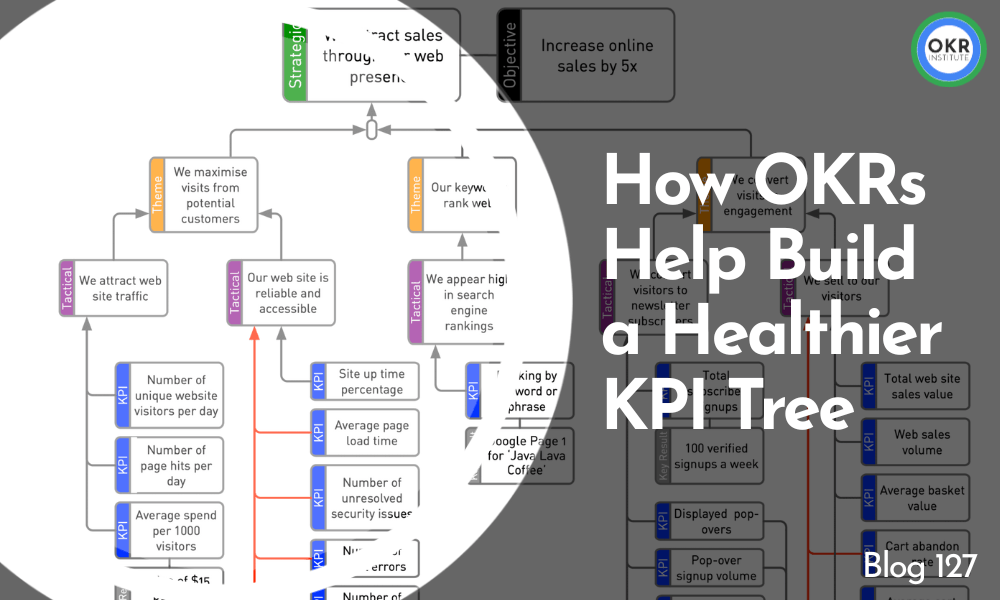
How OKRs Help Build a Healthier KPI Tree
From Metric Overload to Outcome-Driven Performance
Many organizations invest heavily in KPIs. They build detailed KPI trees, dashboards, and scorecards—yet still struggle with focus, alignment, and execution.
The result is often a bloated or unhealthy KPI tree:
- Too many metrics
- Unclear ownership
- Weak links to strategy
- Reporting without learning
The problem is rarely KPIs themselves.
The real issue is the absence of a clear outcome framework above them.
This is where Objectives and Key Results (OKRs) play a critical role.
OKRs don’t replace KPIs. They make KPI trees healthier, more intentional, and strategically meaningful.
Understanding the Problem: When KPI Trees Become Unhealthy
A KPI tree is meant to show how metrics at different levels contribute to organizational success. In theory, this creates clarity. In practice, many KPI trees suffer from:
- Metrics added year after year without removal
- KPIs derived from functions rather than strategy
- Local optimization at the expense of global outcomes
- Focus on lagging indicators only
- Performance reviews driving metric behavior
Over time, the KPI tree becomes a measurement system without direction.
KPIs are excellent at answering:
What is happening?
But they struggle to answer:
What should we change to win?
Why KPIs Alone Are Not Enough
KPIs are designed to monitor performance, not to set direction.
They:
- Track stability
- Measure efficiency
- Signal deviations
What they don’t do well:
- Create strategic focus
- Encourage ambition
- Clarify priorities
- Drive cross-functional alignment
This limitation is well documented in strategy execution research (Harvard Business Review):
👉 https://hbr.org/topic/strategy-execution
Without a complementary framework, KPI trees tend to grow reactively instead of intentionally.
OKRs: The Missing Layer Above the KPI Tree
OKRs provide the strategic and outcome-oriented layer that KPI trees need.
At their core:
- Objectives define what matters most right now
- Key Results define how success is measured
This makes OKRs a natural bridge between strategy and metrics.
The OKR Institute defines OKRs as a strategic execution system, not a goal-setting exercise:
👉 https://okrinstitute.org/what-are-okrs/
When applied correctly, OKRs sit above KPIs, giving them context, purpose, and relevance.
How OKRs Make KPI Trees Healthier
1. OKRs Anchor KPIs to Strategic Outcomes
A healthy KPI tree grows from clear outcomes.
OKRs force leadership teams to answer:
- What are the most important outcomes we need to achieve?
- What must change, not just improve?
- Where do we intentionally focus—and where do we not?
Only after objectives are clear do KPIs earn their place.
This prevents the common pattern of “because we’ve always measured it.”
2. OKRs Reduce Metric Overload
When every KPI claims importance, none truly are.
OKRs introduce strategic constraint:
- Only KPIs that contribute to active objectives matter right now
- Other metrics remain monitored, but not prioritized
This creates a healthier KPI tree by:
- Pruning low-value metrics
- Reducing reporting fatigue
- Improving decision quality
Fewer, better metrics lead to better conversations.
3. OKRs Clarify Cause-and-Effect Relationships
One of the biggest weaknesses of KPI trees is weak causality.
OKRs help answer:
- Which metrics are drivers vs. outcomes?
- What leading indicators actually influence results?
- Where do teams contribute to shared objectives?
Key results often become validated drivers inside the KPI tree—tested and refined through learning cycles.
This turns KPI trees from static structures into dynamic learning systems.
4. OKRs Shift KPI Reviews from Reporting to Learning
Traditional KPI reviews often focus on:
- Green vs. red status
- Variance explanations
- Defensive justification
OKR-based reviews focus on:
- Confidence in achieving outcomes
- Insights from metric movement
- Experiments and adjustments
This aligns strongly with modern performance and learning research (MIT Sloan):
👉 https://sloanreview.mit.edu/article/building-learning-organizations/
A healthy KPI tree supports learning—not fear.
5. OKRs Help Separate Measurement from Judgment
One of the fastest ways to damage a KPI system is to tie every metric directly to performance evaluation.
OKRs encourage:
- Ambition without punishment
- Stretch goals without gaming
- Transparency without blame
By decoupling OKRs from compensation and individual ratings, organizations protect the integrity of their KPIs.
The OKR Institute strongly recommends this separation to maintain psychological safety:
👉 https://okrinstitute.org/okr-scoring/
Practical Model: OKRs and KPI Trees Working Together
A healthy structure looks like this:
Strategy
↓
Objectives (OKRs) – define desired outcomes
↓
Key Results – validate progress and change
↓
KPIs – monitor performance and stability
In this model:
- OKRs decide what matters now
- KPIs ensure the system stays healthy
Not either/or. Both/and.
Signs Your KPI Tree Is Becoming Healthier with OKRs
You’ll notice improvement when:
- Teams can explain why a KPI exists
- Metrics are reviewed in the context of objectives
- Some KPIs are retired without resistance
- Cross-functional conversations increase
- Leaders talk more about outcomes than activities
Health shows up in behavior, not dashboards.
Common Mistakes to Avoid
To keep the KPI tree healthy, avoid:
- Turning OKRs into another KPI layer
- Copying KPIs directly into key results
- Setting too many OKRs at once
- Using OKRs as performance evaluation tools
- Skipping regular OKR check-ins
Sustainable impact requires discipline and leadership ownership.
Final Thoughts: From Measurement to Meaning
KPI trees are powerful—but only when they grow in the right direction.
OKRs provide:
- Direction
- Focus
- Strategic coherence
They turn KPIs from isolated metrics into signals that matter.
Organizations that combine OKRs and KPIs effectively don’t measure more.
They measure better—and act faster.
Further Reading
Strategy Execution Insights (HBR): https://hbr.org/topic/strategy-execution
OKR Institute Knowledge Hub: https://okrinstitute.org/resources/
OKR Examples Across Industries: https://okrinstitute.org/okr-examples/

CEO of the OKR Institute
Related Courses



Recent Posts



Tags
#OKR
#OKR Implementation
#kpi tree