
The Weekly Rhythm That Keeps OKRs Alive
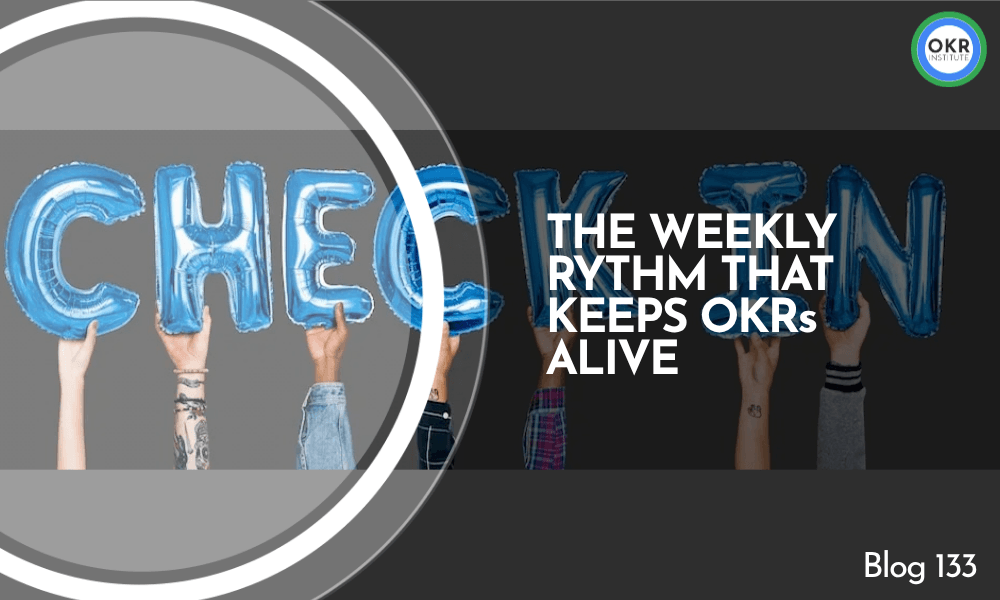
The OKR Check-In: The Weekly Rhythm That Keeps OKRs Alive
Most OKR programmes don’t die at the writing stage. They die somewhere around week six of the quarter, when the OKR check-in quietly falls off the calendar and the goals go back to being a document nobody opens. The objectives were fine. The key results were measurable. What broke was the rhythm that was supposed to keep them in front of people.
This is the part of an execution system that gets the least attention and does the most work.
What is an OKR check-in?
An OKR check-in is a short recurring team meeting where people update progress on their key results, surface what is blocking them, and agree what they will do in the coming week. It is a working session about the next seven days, not a status report to management.
The distinction matters more than it sounds. A status report asks people to justify where they are. A check-in asks them what they are going to do about it. Teams can tell which one they are in within about two minutes, and they calibrate their honesty accordingly.
How often should teams check in on OKRs?
Weekly at team level, with a longer review each quarter. IBM’s guidance puts it plainly: “The OKR cycle typically operates on a quarterly cadence“, with “monthly reviews at the department or division level” and “weekly or biweekly team check-ins”.
Weekly is not an arbitrary number. It is short enough that a stalled key result gets noticed while there is still time to act, and long enough that people have actually done something between meetings. Biweekly works for teams whose work moves in longer arcs, research, procurement, anything with external dependencies measured in weeks. Monthly does not work at team level. By the time a monthly meeting notices a problem, a third of the quarter is gone.
How long should an OKR check-in be?
Fifteen to twenty minutes for a single team. Weekdone describes it as “a quick 15-20 minute meeting where you and your team reflect on the progress of Team OKRs and set new priorities for the upcoming week”, and Leapsome’s guidance is similar, recommending “no longer than 15 minutes for smaller teams or 30 minutes for large ones“.
If your check-in runs to an hour, it has stopped being a check-in. What usually happened is that the meeting absorbed problem-solving. Someone raises a blocker, four people start solving it, and the other six sit through a conversation they have no part in. Name the blocker in the meeting and solve it after, with the two people who own it.
What belongs on an OKR check-in agenda?
Four segments, in order, with a hard stop on each. The agenda is deliberately narrow because the value of the meeting comes from its predictability, not its coverage.
| Segment | Minutes | The question it answers | What ends it |
|---|---|---|---|
| Key result update | 5 | Where is each key result against where it should be by now? | Every KR has a current number and a direction |
| Confidence call | 3 | Which key results do we now think we will miss? | Each owner has said high, medium or low, out loud |
| Blockers | 5 | What is stopping a key result from moving, and who can unblock it? | Each blocker has one named owner and a date |
| Next week’s priorities | 4 | What are the two or three things that move a key result this week? | Each person has named theirs |
The confidence call is the segment teams skip first and the one that earns the meeting. A key result sitting at 40 percent in week six tells you very little on its own. A key result at 40 percent whose owner has just moved from high confidence to low tells you something is wrong now, while you can still redirect people.
How do you track OKR progress between check-ins?
Owners update their own key results before the meeting, not during it. The check-in is for interpreting the numbers, and a team that spends its first eight minutes reading updates aloud has converted a working session into a reporting ritual.
What you track it in matters far less than who updates it. A shared spreadsheet that five owners maintain honestly beats a well-designed platform that one programme manager fills in on everyone’s behalf. Second-hand updates are the most reliable early sign that a rollout is drifting back towards paperwork. The person closest to the work has stopped touching the goal.
Should you score OKRs in the weekly check-in?
No. Score quarterly, check in weekly, and keep the two conversations apart. The What Matters team’s own guidance draws the same line: check-ins are “conversations about the action to get it back on track“, while grading OKRs is “a binary process” about judging performance, run “on a regular rhythm (i.e., quarterly) during each OKR cycle”.
The reason is behavioural. Weekly grading turns every check-in into a performance review, and teams respond to performance reviews by setting targets they know they can hit. You get accurate reporting on unambitious goals. IBM describes the common scoring approaches as a yes or no evaluation, a red, amber and green rating, or a 0 to 1 numerical score, with aspirational OKRs expected to land around “60-70% achievement”. A team that expects to land at 0.7 cannot be graded weekly against 1.0 without learning to aim lower.
What is the difference between an OKR check-in and a status meeting?
A status meeting reports on activity. A check-in reports on outcomes and then changes what happens next.
Teams that already run a weekly operational meeting usually try to bolt the OKR check-in onto it. That works only if the operational half comes second. Whichever conversation runs first sets the frame for the whole meeting, and the moment the OKR update follows forty minutes of project status, it becomes a closing item that gets cut when the meeting overruns. Run the check-in first, or run it on a different day.
Why do OKR check-ins stop happening after six weeks?
Because nothing in the meeting was ever consequential enough to defend it against a calendar conflict. A check-in survives when missing it visibly costs the team something, and dies when it is a place where numbers get read out.
The pattern our coaches see most often is a check-in with no decisions in it. If a meeting never changes anyone’s week, people are right to drop it.
Who should run the OKR check-in?
The team lead, not a programme manager and not an external coach. Ownership of the meeting and ownership of the outcomes need to sit in the same place, otherwise the team is reporting to the process rather than using it.
An OKR coach earns their place during the first two or three cycles, modelling the facilitation and then handing it back. A coach who is still running check-ins in month nine has built a dependency, not a capability. This is the difference between training that produces certificates and OKR implementation that produces behaviour change, and it is the single hardest thing to get right in a rollout.
Frequently asked questions
How long should an OKR check-in meeting be? Fifteen to twenty minutes for a single team, up to thirty for a large one. Anything longer usually means problem-solving has migrated into the meeting.
Should OKRs be graded every week? No. Grade quarterly. Weekly grading pushes teams towards targets they are confident of hitting, which is the opposite of what an ambitious key result is for.
Can an OKR check-in be asynchronous? Partly. Key result updates should be written before the meeting either way. The confidence call and the blocker conversation need people in the same room or on the same call, because they depend on hearing hesitation.
What if a key result hasn’t moved at all? Say so, and treat it as a signal about the key result rather than the person. A metric that hasn’t moved in four weeks is usually measuring something the team cannot directly influence.
Who attends an OKR check-in? The team that owns the key results, and nobody else by default. Adding observers changes how candidly people report.
How do we restart a check-in that has lapsed? Cut the OKR set before you restart the meeting. Cadence rarely fails on its own. It fails because there were too many key results for a twenty-minute conversation to cover.
If your check-ins have quietly stopped happening, that is a cadence problem before it is an OKR problem, and it is usually fixable inside one quarter. Our coaches work through exactly this in the 90-Day Execution Sprint.
About the author
Dirk Schmellenkamp is Founder and CEO of the OKR Institute, which has certified more than 70,000 practitioners and run OKR implementation programmes for over 1,000 organizations across 50+ countries since 2017. The OKR Institute is accredited by the International Coaching Federation, the Association for Coaching and HRD Corp.

CEO of the OKR Institute
Related Courses



Recent Posts


Tags
#OKR
#OKR AI agents
#trends 2026