SELF-DRIVEN TEAMS WE'VE BUILT
Trusted by Leading Brands
Partnering with Fortune 500s, SMEs, and high-growth start-ups to build self-driven teams that turn strategy into measurable results.










Learn to build self-driven, outcome-focused teams that deliver impact.
Write better OKRs, faster
Partnering with Fortune 500s, SMEs, and high-growth start-ups to build self-driven teams that turn strategy into measurable results.
Join 70k+ practitioners, certified to lead transformation, execute strategies, and deliver measurable results.
Four globally recognized certifications. One proven path to OKR mastery.
The hardest part of OKRs isn't writing them, it's building teams that genuinely own them.
Close the gap between strategy and outcomes with our proprietary framework.
See how leading organizations across industries have transformed their performance with our OKR expertise.
Learn from world-class OKR coaches and join a global community of certified practitioners shaping tomorrow's high-performance organisations.

Foundation Course
A great starting point to build a strong foundation and understand the purpose of OKRs.
Practitioner Course
Sharpen your OKR skills and lead your team to consistent, measurable success.
Leadership Course
Most OKR programmes stall because leaders don’t change how they lead. This course does.
Implementation Mastery Course
Prepares you to build, lead, and scale OKR implementations that deliver results.
Professional Course
Master OKR coaching and lead sustainable, high-impact implementations.
Live online sessions across time zones, pick the slots that fit your schedule.
Not just OKR theory, but hands-on workshops that build the habits, alignment, and team ownership that actually stick.
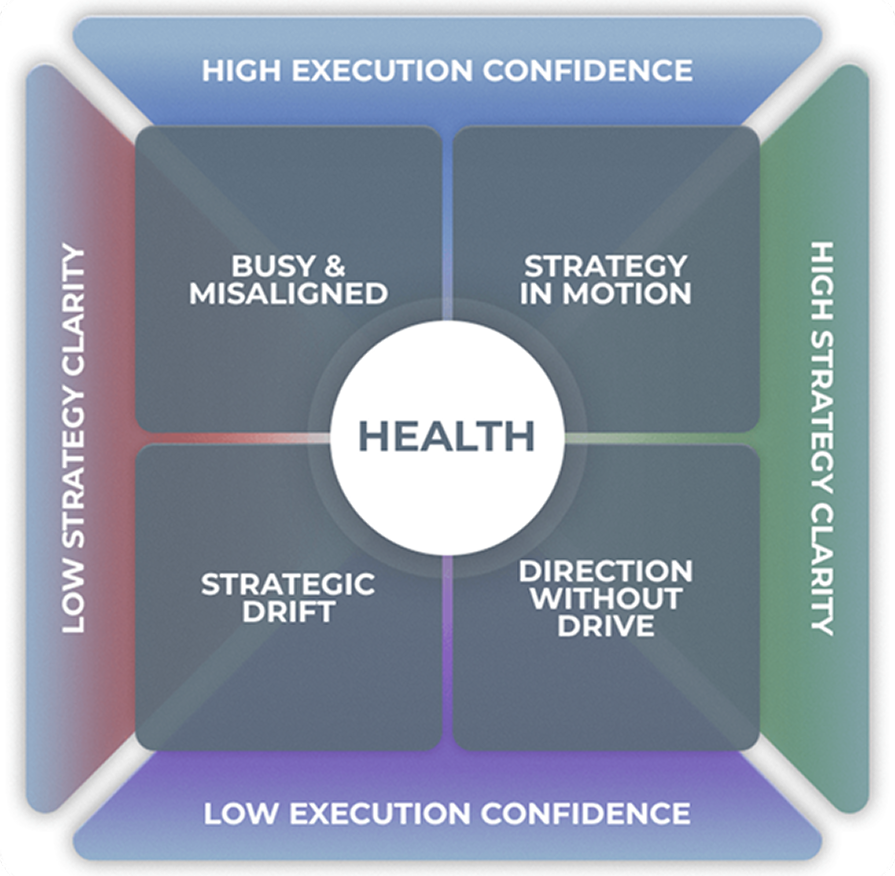
Most organizations don't fail because of a bad strategy. They fail because clarity breaks down, priorities drift, and teams lose direction.
The Execution Health Check gives you an instant read on exactly where execution is breaking down in your organization, and what to fix first.
Get your quadrant score in 2 minutesThe Team-to-Impact Cycle™ is the execution framework behind every OKR certification and coaching engagement.
Designed for real organizations with real complexity, it connects weekly team rhythms to quarterly priorities and annual strategy, so execution becomes a habit, not a hope. Used by 1k+ organizations across 50 countries to close the gap between strategy and outcomes.
Learn about TIC™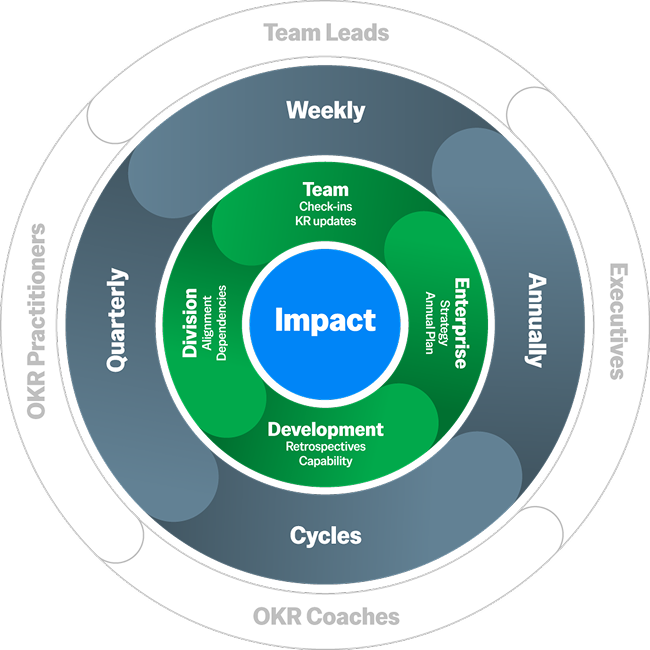

Work through a compressed sprint cycle on a real objective. Set the KPI-OKR Tree, run one decision review, and leave with a rhythm your leadership team can repeat.
Book a working sessionOKR Institute is the world's leading authority on Objectives and Key Results, dedicated to helping organizations build self-driven, outcome-focused teams.
GLOBALLY CERTIFIED
We help organizations move from ambition to impact by embedding OKRs into leadership behavior, team ownership, decision-making, governance & cadence.
OKRImpact Board™A global community of 18k+ certified professionals keeps you sharp long after certification.
Exercises built around your organization's actual situations. 1k+ programs delivered across industries and team sizes.
ICF-credentialed coaches with years at Microsoft, Deloitte, and Allianz. Active across 50+ countries and 5+ industries.
1k+ organizations recognize OKRI credentials in hiring. Results-focused, not just hours logged.
Most organizations don't struggle with strategy; they struggle with execution.
Our programs combine live coaching, hands-on exercises, and self-paced modules so you learn the way real execution happens, iteratively and in context.
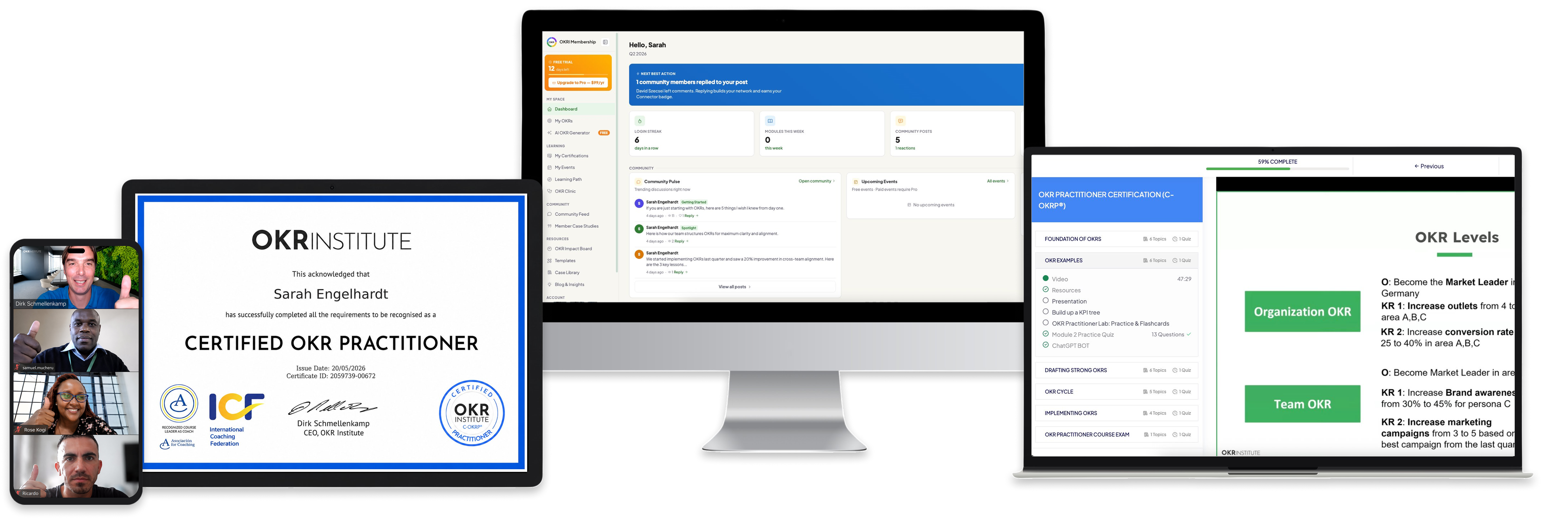
From first-time learner to professional coach, our certifications are internationally recognized by associations, universities, and Fortune 500 companies.
Build a solid foundation and understand the purpose of OKRs.
Sharpen your skills and lead teams to measurable success.
Lead with confidence and drive cross-functional alignment.
Build, lead, and scale OKR implementations that deliver results.
Master OKR coaching and lead sustainable, high-impact implementations.
Authentic experiences from professionals who turned OKR certification and coaching into real organizational transformation.
After reading “Measure What Matters”, I wanted to master the art and science of OKRs. The OKR foundation and practitioner course from OKR Institute delivered exactly that. Spot on. Accessible. And something that can give you enough confidence to start the journey.

I found the OKR course to be very interesting, our OKR Coach was great, he worked around our schedule, and was very helpful in answering all of the questions we had. The course was thorough and left us ready to grow OKR adoption with our clients.

I already knew the overall OKR framework through the Foundational course, but the OKR Practitioner class not only clarified the many questions I had, but also made it more practical through the many years of experience the OKRI Coaches shared with us, reinforcing my conviction that OKR is the right tool to make a strategy more actionable.

The OKRI Practitioner workshop helped me to deploy OKRs in our organization, to align and set the right OKR Cycle to our business rhythm.

The OKR training that I took from OKR Institute was a mind-opening training. It was beneficial to understand the need and impact of OKRs within the organization. The exchange between the participants from different sectors also created a good synergy and provided various perspectives.
Highly engaging, interactive learning and exercises, delivered by passionate knowledgeable people, to enable better goal setting and can be applied to anything you are doing! This OKR course enhanced the learning experience and enabled me to internalise the principles and gain confidence in applying them.

Comparing all the OKR courses out there, I found the ones by OKR Institute to be highly educational with a clear certification path. They help you learn, understand, and improve on creating great OKRs during the period of the course. I highly recommend OKR Institute.
It was an engaging and productive workshop. I signed up for the OKR Leadership and Practitioner Course and could bring my knowledge on OKRs to the next level.

We have offices all around the globe and bringing in more alignment via OKRs helped us to break up silo effects and align teams vertically and horizontally toward our corporate strategies

I could enhance my OKR knowledge via the OKR Practitioner Course. I can strongly recommend this workshop.

The OKR Practitioner workshop gave me the knowledge to connect my Scrum projects with OKR. Overall a very good experience.

After reading “Measure What Matters”, I wanted to master the art and science of OKRs. The OKR foundation and practitioner course from OKR Institute delivered exactly that. Spot on. Accessible. And something that can give you enough confidence to start the journey. This course is a must, for anyone who is serious about setting team goals, making progress, and adding value.

As a growth consultant to the creative industry, I’ve strongly advocated the OKRs to create sustainable and purposeful growth. Having completed the OKR Practitioner, I was also keen to undertake the OKR Leadership course. The course focused on the skills needed as an OKR leader to influence and inspire teams. I’m glad I took this course and will use the learnings in my approach as an OKR coach.

The material and presentation of the OKR course were both excellent. I enjoyed the practical examples, digital toolset, and professional presentation. I particularly appreciated the personal touch and practical examples presented during the training.

I am writing to express my sincere gratitude for the invaluable knowledge and insights I gained from the OKR course. The course was enlightening and has significantly boosted my confidence in drafting effective OKRs, both for myself and for my team.

The coach demystified the concept of OKRs and provided us with a broad roadmap for implementation. His deep understanding of OKR methodology and practical insights helped us see the potential for driving alignment and focus across our teams. 20Cube cannot recommend OKRI’s OKR session highly enough.

During the phase of OKR implementation and transitioning from OKRs to KPIs, Omantel leveraged the expertise of OKR Institute to certify employees as OKR practitioners and enhance the team’s skills to support the transformation. These sessions were informative and significantly aided in the successful implementation of OKRs.

Stay ahead with expert articles, frameworks, and practical guides from the world of OKRs.
At OKR Institute, we go beyond training to deliver end-to-end OKR enablement for organizations. Our services include:
Our goal isn’t just to teach OKRs, it’s to embed them into how your organization actually operates.
Both our credentials and our approach set us apart. Our certifications are recognized in over 80 countries and accredited by leading bodies including the ICF (International Coaching Federation), the Association for Coaching, and HRDCorp, giving your qualification real weight wherever you work.
But recognition is only half the story. Unlike providers who stop at the classroom, we stay with you through rollout, challenges, and refinement. Our coaches bring real-world implementation experience, and because we built our own OKR platform at okri.io, we’ve lived the practice we teach, not just the theory.
Organizations that successfully adopt OKRs consistently report stronger strategic alignment, faster decision-making, and improved accountability across teams.
We can share relevant case studies and help you build a business case tailored to your organization’s goals and challenges.
We are happy to guide you. A short conversation with our team is usually enough to understand your goals, current OKR maturity, and the right starting point.
There is no one-size-fits-all answer, and we will always recommend what genuinely fits your situation. You can reach out to us via [email protected].
Absolutely. Many of our clients engage us on a recurring basis, for quarterly reviews, refresher sessions, new leader onboarding, or as their OKR practice evolves and scales.
AI is a powerful assistant, but it is not a substitute for expert-led learning and real-world implementation experience.
The OKR Institute's courses provide a structured, proven methodology for designing, implementing, and sustaining OKRs, built on years of experience working with leading organizations around the world. You will gain practical insights, real-world implementation lessons, and best practices that AI alone cannot provide, along with guidance from experienced practitioners, real case studies, and an internationally recognized certification.
AI can help you write better OKRs or generate ideas. But it cannot replace the experience, judgment, coaching, and practical know-how required to successfully implement OKRs across teams and organizations.
Connect, share insights, and grow with OKR practitioners and certified coaches from around the world.


Start your membership. Join practitioners worldwide.
The software gives teams one place to align on priorities, track progress, and execute with greater accountability.
Try for free